Call us: 0286775222
Location
.png)
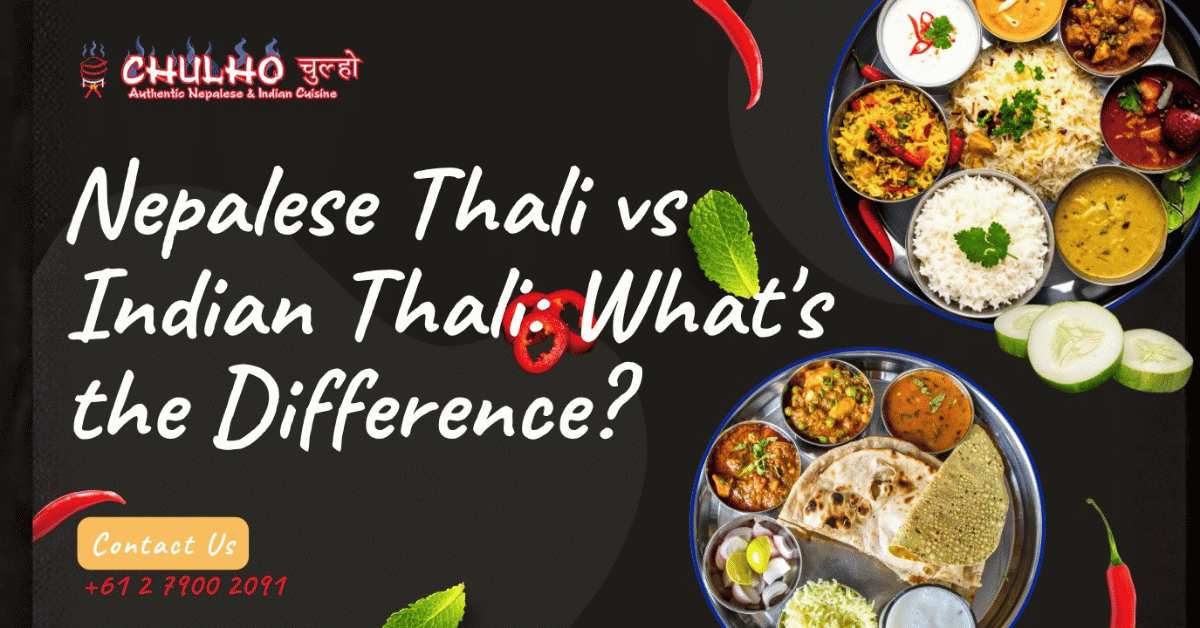
If you love South Asian food, you have probably heard of thali. It is a platter meal. It comes with rice, lentils, curries, and sides. But here is the thing: a Nepalese thali and an Indian thali are not the same.
They look similar. They both come on a round plate. But the flavours, the ingredients, and the whole experience are very different.
Let's break it down.
A thali is a set meal served on one plate. The word "thali" means plate in Hindi and Nepali. It usually includes:
Both Nepali and Indian cuisines have their own version. But they come from different food traditions.
A traditional Nepali thali is built around dal bhat tarkari. Dal is the lentil soup. Bhat is steamed rice. Tarkari is the cooked vegetable curry.
This is not just a meal in Nepal. It is eaten twice a day by most Nepali people.
A standard Nepali thali includes:
The flavours are earthy and clean. Spices are present but never overwhelming. Mustard oil, fenugreek, and cumin are common. The meal is wholesome and grounding.
Some restaurants in Sydney also serve a Newari khaja set. That is a different spread. It features beaten rice, choila (spiced meat), bara (lentil patty), and achar. It is a Nepalese food experience worth trying on its own.
Indian thali varies by region. North Indian thali, South Indian thali, and Rajasthani thali are all very different. But the idea is the same a full meal on one plate.
A common Indian thali includes:
Indian thalis are often richer. They use more cream, ghee, and dried spices. Flavours are bold and layered. North Indian versions lean towards butter and tomato-based gravies. South Indian versions use more tamarind, coconut, and rice.
Nepalese Thali
Indian Thali
Base
Steamed rice (bhat)
Rice or roti/chapati
Dal
Thin, light lentil soup
Thick, spiced dal
Spice Level
Mild to Medium
Medium to bold
Key ingredients
Gundruk, achar, mustard oil
Ghee, cream, tamarind
Uniqueness
Fermented sides, simple flavours
Regional variety, rich gravies
Dessert
Rarely included
Often included
The Nepali thali is cleaner and lighter. The Indian thali is more indulgent and complex. Both are deeply satisfying meals.
Is Nepali Food Similar to Indian Food?
This is a common question. The short answer is yes and no.
Nepali cuisine and Indian cuisine share some spices and techniques. But Nepali food uses fewer heavy sauces. It relies more on fermented ingredients like gundruk. It also uses buffalo meat (buff) more commonly than beef or pork.
The dal bhat of Nepal is simpler than its Indian counterpart. It is everyday comfort food. Not a restaurant showpiece.
Which Thali Is More Spicy — Nepali or Indian?
Indian thali is usually spicier, especially South Indian and Rajasthani versions. Nepali thali tends to be more balanced. It is flavourful but not fiery.
That said, it depends on the restaurant and the cook.
Is a Nepali Thali Worth Trying?
Absolutely. The difference between a Nepalese thali and an Indian thali comes down to roots. One comes from the Himalayas. One comes from a vast subcontinent with dozens of food cultures. Both are worth your time.
If you have never had a Nepali thali before, start with dal bhat tarkari. It is simple. It is filling. And it will make you come back for more.
Where to Eat Nepali Thali in Sydney?
Sydney has a growing Nepalese food scene. Chulho in Harris Park serves a full thali set with basmati rice, dal, saag, pickle, papadum, salad, and dessert. You can pick chicken, lamb, goat, or vegetarian. Chulho also has a second location at Town Hall on Liverpool Street. Both are great spots for authentic Himalayan cuisine in Sydney.
Chulho, as an authentic Nepalese and Indian Cuisine, serves typical Nepali and Indian Dishes in the original taste as its form. Chulho has main focused on the originality of the taste of foods that it offers to all the stepped in personels.
Copyright © 2026 - Chulho Authentic Nepalese and Indian Cuisine. All rights reserved.

